
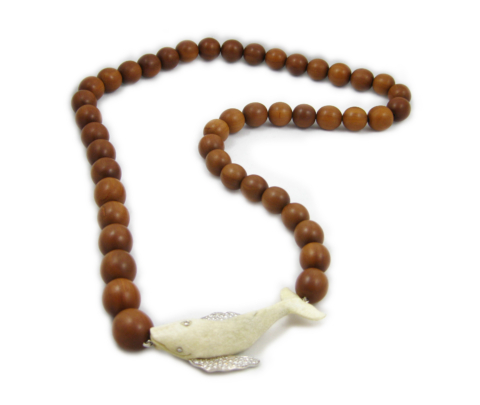
For more than three decades, artist and jewelry designer Katey Brunini has explored the relationship between the precious and the unexpected. Gold, sterling silver, diamonds, pearls, and rare gemstones meet wood, bone, coral, shell, and other natural materials in jewelry that is both raw and refined.
Nature is more than an aesthetic reference in K. Brunini Jewels; it’s material, structure, and philosophy.
The natural world has long provided both the materials and forms behind K. Brunini Jewels. Twigs become precious metal, vertebrae inform sculptural silhouettes, wood is juxtaposed with diamonds, bone and coral are elevated alongside gold, pearls and precious gemstones.
Brunini brings together organic materials and precious ones, instead of segregating the two worlds. Their contrasts– polished and weathered, delicate and enduring, precious and elemental– form a visual language rooted in the power and grace of nature.
The Twig collection, for example, draws from the strength and structure of trees, pairing precious metals and gemstones with materials such as cocobolo wood and baroque pearls. The result blurs the boundary between the natural object and the jewel.
In K. Brunini jewelry, materials traditionally associated with fine jewelry coexist with elements drawn from the natural world. These have included wood, bone, antler, coral, shells and pearls, alongside gold, platinum, sterling silver, diamonds, opals, and rare gemstones. The use of unconventional materials does not make the jewelry less precious. Instead, their histories, textures, and imperfections become part of each piece.
Brunini’s work with these materials has been documented throughout her career. JCK has described her designs as combining organic materials such as wood and antler with diamonds, while Rapaport has documented her use of fossilized wood, bone, pearls, opals, and other natural materials.
K. Brunini’s relationship with nature expands beyond material. Across collections including Twig, Vertebrae, DNA, Spider Web, Objects Organique, and Spirit Animals, forms found in trees, anatomy, animals, and biological structures become the starting point for wearable sculpture.
A branch may become a bracelet. A vertebral form may become a ring. The double helix of DNA becomes ornament. The objective is to interpret nature’s structures, contradictions, and symbols through fine jewelry.
That tension has become one of the signatures of K. Brunini Jewels: where precious metals meet wood, diamonds meet bone, baroque pearls rest against branch-like textures, polished gemstones emerge from sculptural forms inspired by the earth. The materials retain something of where they came from while becoming something new.
It is this relationship between raw and refined that allows natural materials to exist within the tradition of fine jewelry.
Natural materials in fine jewelry can include wood, bone, antler, coral, shells and pearls, as well as naturally occurring gemstones. K. Brunini combines these materials with traditional precious materials including gold, platinum, sterling silver, and diamonds to create jewelry that balances organic form with fine craftsmanship.
Organic jewelry design can refer to jewelry inspired by the forms, textures, and structures found in nature. In K. Brunini’s work, organic design appears both literally through natural materials and conceptually through forms inspired by twigs, vertebrae, DNA, spider webs, and other structures of the natural world.
Yes. Natural materials such as wood and bone can be incorporated into fine jewelry alongside precious metals and gemstones. K. Brunini has worked with wood, bone, and antler throughout her career, often juxtaposing their natural textures with gold, diamonds, pearls, and rare gemstones. Her use of wood and antler in fine jewelry has also been documented by jewelry-industry publications.
Nature influences both the materials and forms of K. Brunini Jewels. Collections such as Twig, Vertebrae, DNA, Spider Web, and Spirit Animals interpret structures found in plants, anatomy and the natural world, while individual works incorporate materials including wood, bone, coral, shell, pearls, and gemstones.
Natural materials are integral to Katey Brunini’s creative process and her exploration of nature, longevity, and transformation. Speaking about her work, Brunini has described natural materials, including petrified wood, as a driving force behind her creative process and connected their durability with jewelry’s ability to unite generations.