
Jewelry occupies an unusual space between object and experience. It can be sculptural without remaining still. Precious without being conventional. Intimate enough to rest against the body, yet expressive enough to communicate something beyond the person wearing it.
For artist and jewelry designer Katey Brunini, this space between art and adornment has been explored for more than three decades. Through precious metals, rare gemstones, natural materials, symbolism, and sculptural form, K. Brunini Jewels approaches fine jewelry as something to be experienced as much as it is worn. The body does not simply display the object, it gives the object life.
Sculpture is concerned with form, volume, texture, material, and the relationship between an object and the space surrounding it. Jewelry can engage with each of these ideas on an intimate scale.
Katey Brunini’s earliest path toward jewelry began with an interest in architecture before shifting toward what she has described as miniature structures in metal and gemstones. That architectural sensibility remains visible throughout her work, where form is rarely secondary to ornament.
The scale may be intimate, but the ideas are not: a twig becomes the structure of a bracelet, vertebrae become rhythm and repetition, horn and antler become sculptural material. A compass, sundial, heart, animal, or fragment of anatomy can be transformed into an object that exists simultaneously as jewel, symbol, and form.
Unlike sculpture displayed on a pedestal, wearable art enters into a relationship with the human body. Its proportions respond to anatomy. Movement changes the way light travels across metal and gemstones. A necklace takes shape around the neck; a cuff acquires meaning through the gesture of an arm; a ring becomes part of the movement of a hand. Throughout K. Brunini’s work, the body becomes more than a place upon which jewelry rests—it becomes part of the composition.
This relationship is particularly visible in works that push beyond conventional jewelry proportions. Body Armor, the final chapter of Brunini’s Shapes of Strength series, transformed ideas of protection and survival into objects including cuffs, shin guards, gauntlets, compass pendants, sundials, and other forms intended to be worn on and around the body. Here, adornment becomes physical and the wearer activates the sculpture.
In wearable art jewelry, material carries meaning beyond monetary value. Gold, sterling silver, diamonds, pearls, opals, and rare gemstones provide one vocabulary. Wood, bone, antler, horn, coral, and other natural elements provide another. K. Brunini Jewels allows these languages to meet.
A polished gemstone beside an organic surface heightens the character of both. A material shaped by nature can retain evidence of its origins even after it has been transformed by the artist’s hand. Precious metal can preserve the irregular structure of something as transient as a branch.
The tension between these materials—raw and refined, organic and constructed, ancient and contemporary—has become fundamental to K. Brunini’s visual language. Materials become more than what the jewelry is made from; they become part of what the jewelry has to say.
Wearable art is not defined by scale or spectacle alone. An object can be quiet and still carry an idea. Throughout Katey Brunini’s collections, forms drawn from nature, science, mythology, anatomy, architecture, and personal experience become symbols. DNA speaks to the structures of life. Vertebrae evoke strength and the architecture of the body. Spirit Animals explore our relationship to the natural world. Body Armor transforms instruments and symbols of protection into personal talismans.
In Cornuti, horn became both material and cultural language. The work explored its presence throughout history and mythology, considering associations with sexuality, superstition, fertility, and protection. Presented at Lux Art Institute as part of a multi-artist sensory experience, the jewelry existed within a broader conversation between jewelry, sculpture, dance, and music. In this context, the jewel becomes an object through which an idea can be carried.
The distinction between fine jewelry and fine art has never been absolute. K. Brunini Jewels has moved between the two worlds for decades, appearing not only in jewelry environments but also museums, galleries, exhibitions, and art fairs. The work of Katey Brunini has been exhibited at institutions and events including, but not limited to, the Carnegie Museum, Art Basel, the San Diego Museum of Natural History, and the Gemological Institute of America Museum.
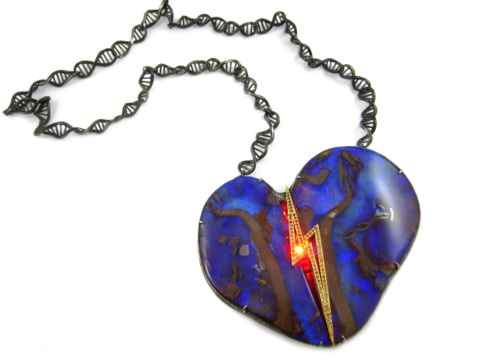
At Art Basel Miami Beach, Brunini’s exhibited work included a raven necklace carved from jet, a butterfly ring with tourmaline wings, and her award-winning Robot Heart necklace—a monumental opal-centered work incorporating light through LED technology.
These pieces demonstrate what happens when the traditional boundaries between jewelry, sculpture, technology, natural material, and storytelling begin to dissolve. Yet, the ability to be worn remains significant. The gallery allows the object to be observed; the body allows it to be lived with.
Wearable art jewelry is jewelry conceived not only as adornment, but as a form of artistic expression. Material, form, symbolism, craftsmanship, and the relationship between the object and the human body can all contribute to its meaning. In K. Brunini’s work, wearable art often brings precious materials together with natural elements and sculptural forms inspired by nature, science, anatomy, mythology, and architecture.
Sculptural jewelry approaches the jewel as a three-dimensional form. Like sculpture, it can explore volume, proportion, texture, structure, negative space, and material. Unlike stationary sculpture, its relationship to the body and the movement of the wearer become part of how the object is experienced.
Jewelry can function as art when it is used as a medium for artistic ideas, expression, symbolism, or experimentation. Fine craftsmanship and precious materials can coexist with conceptual and sculptural concerns, allowing a piece to function both as adornment and as an artwork.
The distinction is not necessarily defined by materials or craftsmanship. Both may incorporate precious metals, gemstones, and highly skilled techniques. Wearable art places particular emphasis on artistic expression, concept, form, material, or the relationship between the object and the body. A piece can therefore belong to both traditions simultaneously.
Katey Brunini approaches jewelry through sculpture, symbolism, natural material, and conceptual storytelling. Her work transforms inspirations ranging from twigs and vertebrae to animals, architecture, protective objects, and anatomy into objects made to interact with the body. Over more than three decades, that work has moved between fine-jewelry environments, galleries, museums, exhibitions, and art fairs.