
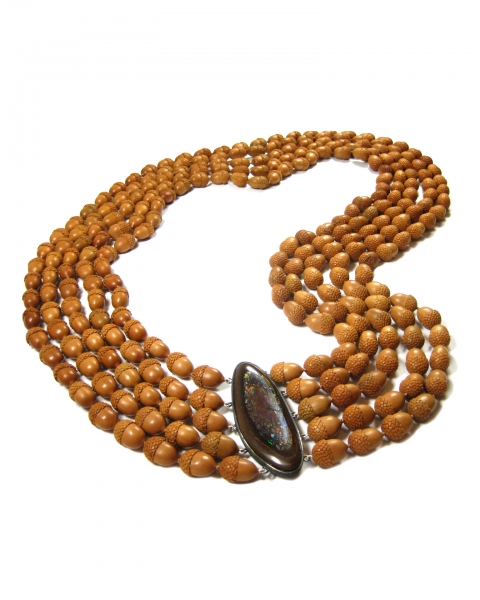
Wood carries a history written by nature. Its grain records growth, time, environment, and transformation. In the hands of artist and jewelry designer Katey Brunini, that organic history becomes part of the language of fine jewelry. For decades, K. Brunini Jewels has challenged traditional ideas of preciousness by placing natural materials in conversation with gold, diamonds, pearls, opals, and rare gemstones. Wood is among the materials that return throughout Brunini’s work as a complement to traditional precious materials and craftsmanship.
Fine jewelry is often defined by precious metals and gemstones, but K. Brunini expands that vocabulary. Wood introduces warmth, grain, texture, and individuality that cannot be manufactured identically from one piece to another. Paired with gold, diamonds, opals, pearls, and other gemstones, its organic character creates the contrast between raw and refined that has long defined Brunini’s work. This juxtaposition allows the inherent qualities of the material to remain visible. The jewelry celebrates the wood in each piece, never disguising it as something else.
The relationship between wood and K. Brunini’s design language is particularly visible in the Twig collection. Inspired by the forms and structures of trees, Twig explores the transformation of an elemental natural object into wearable art. Branch-like forms appear in precious metals while wood, gemstones, diamonds, and pearls create relationships between the organic and the precious. Cocobolo wood has appeared in Twig jewelry alongside 18-karat gold and opal, extending the collection’s connection to trees beyond form and into material itself. The result is a dialogue between nature as inspiration and nature as substance: the structure of the tree becomes the structure of the jewel.
Wood also carries ideas of time and transformation. A tree grows slowly, recording its history through its structure. Wood can survive beyond the living organism from which it came, taking on new meaning as it moves from natural material to crafted object. That sense of longevity resonates throughout Brunini’s approach to jewelry. Her work has incorporated wood in multiple forms, including fossilized wood, bringing geological time into conversation with contemporary craftsmanship. In this context, a jewel becomes more than an ornament. It becomes a meeting point between the natural world, human craftsmanship, and the person who eventually wears it.
Wood and diamonds may appear to belong to opposite worlds. One carries visible grain and organic irregularity. The other is valued for brilliance, structure, and permanence. Gold can be polished to a luminous finish, while wood retains evidence of growth. K. Brunini brings those contrasts together intentionally. Throughout her work, opposing qualities– raw and refined, ancient and contemporary, organic and precious– are allowed to coexist. Wood becomes another way of exploring that balance. Brunini’s work asks the question of what becomes possible when definitions of preciousness are expanded to unconventional natural materials.
Yes. Wood can be incorporated into fine jewelry alongside traditional precious materials such as gold, diamonds, pearls, opals, and other gemstones. K. Brunini has used wood throughout her work, including cocobolo, sawo, and petrified wood, pairing its natural texture and character with fine-jewelry craftsmanship.
Wood offers qualities that precious metals and gemstones cannot replicate, including natural grain, warmth, texture, and organic variation. Each piece of wood carries characteristics created through its growth and environment, giving the material an individual visual history.
Yes. K. Brunini has paired wood with 18-karat gold, diamonds, opals, pearls, and other precious materials. These combinations create a contrast between organic and refined surfaces that is characteristic of Katey Brunini’s design language.
The Twig collection draws inspiration from trees and branch structures. Wood deepens that relationship by allowing the natural material itself to become part of the jewelry, while twig-like forms rendered in precious metals interpret the structures found in nature.
Natural materials are a recurring part of Katey Brunini’s creative process. Wood allows her to explore ideas central to K. Brunini Jewels: nature, transformation, longevity, contrast, and the relationship between raw materials and precious craftsmanship.