
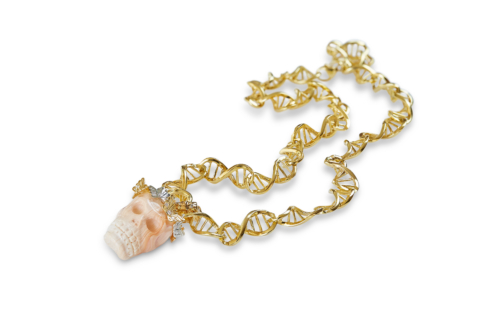
Before form, there is information. Within nearly every cell of the human body, DNA carries the instructions that shape life. Its structure is microscopic yet fundamental: strands joined together, twisting around one another in the recognizable geometry of the double helix.
In the DNA Collection, artist and jewelry designer Katey Brunini brings that hidden structure into view. The helix becomes line, rhythm, repetition, and form. Translated into precious metal and fine jewelry, something normally encountered at a molecular scale becomes intimate enough to wear against the body.
The architecture of life becomes adornment.
DNA is simultaneously information and structure. Its double helix is formed by two strands winding around one another, connected across the center by paired molecular components. The result is a structure that has become one of the most recognizable visual languages of modern science.
For an artist interested in the systems found throughout nature, its geometry offers another way of looking at life. K. Brunini’s work repeatedly examines structures that are essential to the natural world: the branching of a twig, the articulation of a spine, the interconnected threads of a web. DNA moves that investigation to a scale invisible to the eye. Here, structure is not merely something that supports life; it carries its instructions.
Translating DNA into jewelry changes its scale without abandoning its essential rhythm. The twisting movement of the double helix creates a natural relationship with the body. Repetition gives the form continuity, while the spaces between its elements become as important as the material itself.
In jewelry, those qualities can be experienced differently. A structure understood through diagrams and microscopes becomes dimensional. Precious metal gives weight to something normally imperceptible. A form measured at the molecular level becomes something that can encircle a finger, follow the wrist, or rest against the body. Science becomes sculpture, and structure becomes jewel.
DNA carries more than biological information in the cultural imagination. It has become a language for thinking about identity, inheritance, ancestry, connection, and the qualities that pass from one generation to another. Every strand exists as part of a much longer story. Those associations give DNA particular resonance when transformed into jewelry.
Jewelry is itself often connected to identity. It can mark relationships, carry memory, move between generations, or become part of the way an individual presents themselves to the world. The double helix introduces another layer to that relationship: what is worn on the exterior of the body references something fundamental within it.
The DNA Collection belongs to K. Brunini’s broader exploration of Shapes of Strength, in which structures from nature and the body become a vocabulary for jewelry.
A twig grows through branching and adaptation, vertebrae derive strength through articulation and connection, and a spider web distributes tension across an interconnected structure. DNA preserves and transmits the information from which living organisms develop. Each begins somewhere different, but they share an underlying idea: strength can exist through systems, relationships, repetition, and connection.
In DNA, that idea reaches toward life’s smallest architecture. The pattern repeats, the structure continues, and information moves forward.
Much of what defines the natural world exists beyond ordinary human perception. DNA is present throughout life, yet its structure cannot be observed simply by looking at the person, animal, or plant carrying it. It exists beneath the visible surface.
Jewelry reverses that relationship. By translating the double helix into an object worn on the body, the unseen becomes visible. Something internal becomes external; something microscopic becomes sculptural.
This transformation is central to the way K. Brunini approaches nature throughout her work. Nature is not limited to landscapes, animals, or organic materials: it is also pattern, system, and structure. Sometimes, it is also information.
The DNA Collection is a body of fine jewelry by artist and designer Katey Brunini inspired by the structure of DNA and the double helix. The collection translates molecular form, repetition, and movement into sculptural jewelry connected to K. Brunini’s larger exploration of structures found throughout nature and the body.
DNA-inspired jewelry uses the structure, geometry, or symbolism of DNA as a source of design. Some pieces represent the recognizable double helix directly, while others interpret its twisting lines, repetition, or ideas of identity and connection through jewelry.
The double helix has a distinctive twisting structure and carries associations with life, identity, inheritance, and connection. Its repeating geometry can also be translated naturally into dimensional and sculptural jewelry forms.
Yes. DNA is composed of two strands that wind around one another to form a double helix. The familiar spiral representation is a simplified way of visualizing this three-dimensional molecular structure.
DNA is part of K. Brunini’s broader exploration of structures found in nature and the body. Alongside collections such as Twig, Vertebrae, and Spider Web, DNA examines how repetition, connection, pattern, and structure can become the foundation for fine jewelry.
Explore the K. Brunini DNA Collection.