
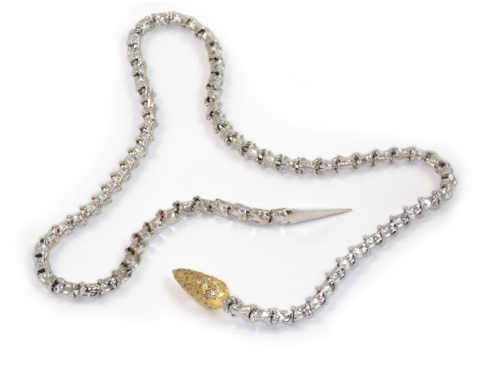
Strength is rarely the absence of movement. The spine supports the body precisely because it can bend. Individual vertebrae form a structure that is protective yet flexible, each element dependent upon the next. In the serpent, that same architecture becomes fluid motion—a body capable of curving, coiling, and changing direction without surrendering its strength.
In the Vertebrae Collection, artist and jewelry designer Katey Brunini transforms this anatomy into fine jewelry. Links become bones, repetition becomes structure. Precious metal follows the sinuous movement of the serpent, creating rings, bracelets, cuffs, earrings, and other forms that draw their character from the architecture of the spine. What begins within the body becomes visible upon it.
The spine is both foundation and movement. Its individual vertebrae protect what is delicate while allowing the body to twist, bend, and respond. No single element creates that strength alone; it emerges through repetition, articulation, and connection. These qualities give Vertebrae its visual language.
Instead of treating anatomy as ornament, K. Brunini draws from its underlying structure. Repeated forms create rhythm where grooves and articulated links recall the segmentation of a spine. Hinged elements allow the jewelry itself to move, translating biological structure into mechanical function. The result is an interpretation of the principles that make anatomy work.
Within Vertebrae, the spine is inseparable from another recurring form: the serpent.
A snake moves through the articulation of its vertebral column. What appears almost liquid is supported by an intricate internal structure—strength expressed through flexibility rather than rigidity. K. Brunini’s Vertebrae jewelry captures this supple energy through repeated and, in some pieces, individually hinged elements. Bracelets and cuffs follow the movement of the wrist, rings wrap the finger in rhythmic grooves, and earrings reduce the language of the collection to a smaller gesture while retaining anatomical character.
The serpent is present without requiring literal representation. Its movement is embedded in the structure of the jewel.
The human body has always offered artists a language of proportion, structure, vulnerability, and strength. For K. Brunini, anatomy becomes a source from which form can be constructed.
This idea extends throughout Shapes of Strength, the larger body of work that includes Twig, Vertebrae, DNA, Spider Web, Objects Organique, Spirit Animals, Body Armor, and other K. Brunini collections. Natural and biological structures are examined for the systems that allow them to survive, connect, move, and endure.
In Vertebrae, that investigation turns inward. The structure normally hidden beneath the body becomes the structure worn upon its surface, and anatomy becomes adornment.
A vertebral column is composed of individual elements, but its strength exists through their relationship. That idea of interdependence gives the collection a meaning beyond anatomy: one form follows another and each link participates in the movement of the whole. Rigidity gives way to articulation, allowing strength and flexibility to exist simultaneously.
This duality appears repeatedly throughout K. Brunini’s work. A twig can be delicate yet resilient. A spider web can appear fragile while depending upon extraordinary structural logic. DNA transforms repetition into the architecture of life. Vertebrae expresses the same idea through the body itself. Strength does not always mean resisting movement; sometimes strength is the ability to move without losing structure.
When the architecture of the spine is translated into jewelry, its relationship to the body changes. A vertebra-inspired bracelet moves around the wrist instead of within the back. A ring compresses the rhythm of the spine into the scale of the finger. Precious metal gives permanence to a structure defined by motion.
The transformation creates a dialogue between the anatomy that supports the wearer and the object worn upon them. This is where Vertebrae becomes more than anatomical reference. The collection takes something essential but normally unseen and gives it external form. Structure becomes surface, movement becomes ornament, anatomy becomes sculpture, and the body becomes both inspiration and setting.
The Vertebrae Collection is a body of fine jewelry by artist and designer Katey Brunini inspired by vertebral structure and the sinuous movement of the serpent. The collection translates repeated anatomical forms into rings, bracelets, cuffs, earrings, and other jewelry in precious metals.
Vertebrae draws from the architecture of the spine and the supple movement of the snake. Repetition, articulation, flexibility, and structural strength inform the collection’s forms, allowing anatomy to become a language for sculptural fine jewelry.
Yes. The collection interprets the forms and structural principles of vertebrae through fine jewelry. Rather than simply reproducing a spine, Katey Brunini explores its repetition, movement, connection, and ability to combine strength with flexibility.
The serpent expresses the relationship between structure and movement at the center of Vertebrae. A snake’s articulated spine allows its body to move with extraordinary fluidity. K. Brunini translates that sinuous quality into repeated grooves, links, and articulated jewelry forms.
K. Brunini’s Vertebrae designs have included rings and bands, bracelets, cuffs, earrings, and other forms of fine jewelry. Pieces have been created in materials including 18-karat gold and sterling silver, with some designs using individually hinged elements to create movement.
Explore the K. Brunini Vertebrae Collection.