
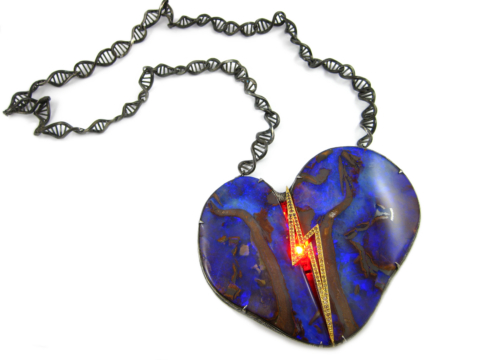
Precious jewelry occupies an important space in art history. Jewelry is both object and experience. It is sculpture and movement. Intimate, expressive, and able to communicate without words. Through precious metals, rare gemstones, natural materials, symbolism, science, and sculptural form, K. Brunini Jewels approaches fine jewelry as something to be experienced. The body does not simply display the object, it gives the object life. Katey Brunini’s canvas is the human body.
Sculpture is concerned with form, volume, texture, material, and the relationship between an object and the space surrounding it. Jewelry engages with each of these intimately.
Katey Brunini’s path began in 1992 with an interest in architecture before shifting towards miniature structures in metal and gemstones. That architectural sensibility remains visible throughout her work, much like a mashup of the Egyptian Pyramids and magical realism.
The scale may be petite, but the ideas are not: a Twig becomes the structure of a bracelet, Vertebrae become rhythm and repetition, DNA brings together all walks of life, Spirit Animals connect humans to the fauna, a Spider Web becomes immortalized, Objects Organique explore the magic of the four elements, Skipping Stones illustrates the beauty of the ripple effect, Body Armor honors our inner strengths, and Brutalism captures the beauty of raw and refined.
Throughout K. Brunini’s work, the body becomes more than a place upon which jewelry rests—it becomes part of the composition. Movement changes the way light travels across metal and gemstones. The balance of metal, gem, and proportion come alive with the energy of the wearer.
Gold, sterling silver, diamonds, pearls, opals, and rare gemstones provide one vocabulary. Wood, bone, and coral provide another. K. Brunini Jewels allows these languages to meet. A polished gemstone beside an organic texture heightens the character of both. Precious metal can preserve the irregular structure of bark.
Raw and refined, organic and constructed, ancient and contemporary—tension exists in her unique material juxtapositions. Jewels speak.
Wearable art is not defined by scale or spectacle alone. Throughout Katey Brunini’s collections, forms drawn from nature, science, mythology, anatomy, architecture, and personal experience become symbols. DNA speaks to the structures of life. Vertebrae evokes the strength and architecture of the body. Spirit Animals explore our relationship to the natural world. Body Armor transforms instruments and symbols of protection into personal talismans.
K. Brunini Jewels has moved between the two worlds for decades, appearing not only in jewelry environments but also museums, galleries, exhibitions, and art fairs. The work of Katey Brunini has been exhibited at institutions like, the Carnegie Museum, Art Basel, the San Diego Museum of Natural History, the San Diego Museum of Art, and the Gemological Institute of America Museum, Laguna Art Museum, Museums of Agricultural Sciences, Alfie Norville Museum, Kent State Museum, and the Headley-Whitney Museum of Art. K. Brunini Jewels is showcased in stores across the globe, and is represented in the United States at many stores, including, but not limited to: Alchemy Jewelers, Jensen Stern, Afterglow, Neiman Marcus, JEN Statement Jewelry, Wilkes Bashford, Argyle & Valentine, Nordstrom, Belle Cose, Oster Jewelers, Squash Blossom, Stanley Korshak, Marissa Collections, Don Purcell, Yafa Signed Jewels, Elevated Matter, Mitchells Group, Stella Flame Gallery, and Bergdorf Goodman.
These pieces demonstrate what happens when the traditional boundaries between jewelry, sculpture, technology, natural material, and storytelling begin to dissolve. The moment her jewels touch the body, the works become vital.
Katey Brunini approaches jewelry through sculpture, symbolism, natural material, and conceptual storytelling. Her work transforms inspirations ranging from twigs and vertebrae to animals, architecture, protective objects, and anatomy into objects made to interact with the body. Over more than three decades, that work has moved between fine-jewelry environments, galleries, museums, exhibitions, and art fairs.